Norfolk panel reviews recall petition, takes no vote
The Norfolk Advisory Committee reviewed, but did not vote on, a citizen's petition to create the town's first recall procedure for elected officials.
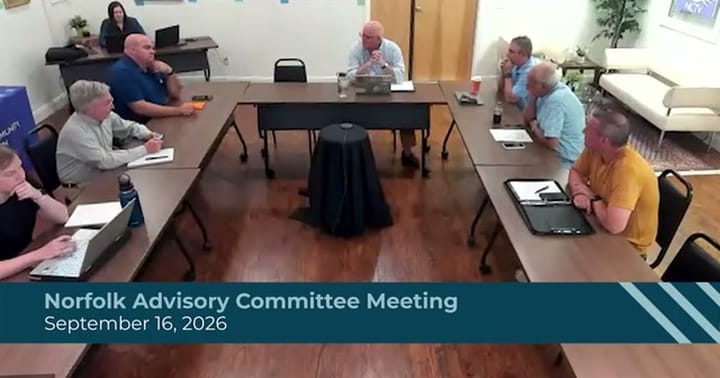
Other Committee · Meeting of September 16, 2026
NORFOLK — The Norfolk Advisory Committee reviewed, but did not vote on, a citizen's petition to create the town's first recall procedure for elected officials. Petitioner Jack Oliveri said the proposal grew out of a town inspector general's report and would let voters remove an official with signatures from 10 percent of registered voters in each of Norfolk's four precincts, about 200 per precinct. Member Jonathan argued the draft lacks defined grounds for recall and risks "personal vendettas," while member Ken, citing limits on select board oversight, said "this thing is well-intended, but as written, I wouldn't support it." Oliveri countered that "being a volunteer does not excuse poor performance" and said he trusts the town's roughly 8,200 registered voters to judge legitimate cause.
Members also flagged that Section 9 of the draft is improperly worded for a home rule petition to the state Legislature. The petition is already certified for the town meeting warrant.
In the full story:
- Who Was There
- Organizations And Documents Referenced
- The complete report — 1,995 words
Source: the Other Committee meeting of September 16, 2026, reported from the official video recording and transcript.
The Full Article
A Citizen's Petition Born of a Town Scandal
Resident Jack Oliveri brought the Norfolk Advisory Committee a citizen's petition to create the town's first recall procedure for elected officials, telling members the idea took shape over the past six months after a town inspector general's report raised concerns about the conduct of a town employee under the town administrator. Several committee members noted the town had seen turnover in a key operational role in recent years. The question before the committee was not whether to adopt the petition, which has already been certified for the warrant, but whether to flag problems and propose amendments before it reaches town meeting and, potentially, the state Legislature.
Oliveri said Norfolk currently has no statewide or local recall procedure, and that any such mechanism must be built town by town. "There's no statewide procedure for recall elected officials. Every town has got to implement their laws," he said. He modeled his draft on bylaws already enacted in several Massachusetts towns, citing Carver as a primary source along with towns he identified as Wellesley and Westford or Westborough, though he acknowledged he could not recall every town's name with certainty.
The Petition's Mechanics: Signatures, Timelines and Elections
The draft, as presented, applies only to elected officials, not appointees, and only to those with more than six months remaining in their term. Section 2 requires a recall petition to be filed with the town clerk as an affidavit naming the official and stating the grounds for recall, intentionally left broad rather than enumerated. The petition then needs signatures from at least 10 percent of registered voters in each of Norfolk's four precincts, which Oliveri estimated at roughly 200 voters per precinct, noting that organizers typically collect more than the minimum because some signatures are invalidated.
Oliveri told the committee he is proposing two amendments based on conversations with Town Clerk Carol. The first extends the window to file signatures from the original 20 days to 90 days; Carol told him 20 days was not enough time to gather the required signatures given validation issues, including unregistered signers and illegible addresses. The second amendment addresses an ambiguity in Section 1: whether the six-month cutoff for triggering a recall is measured from an official's original election or their most recent re-election. The group agreed, after discussion, that the clock should run from the most recent election date, not an official's cumulative time in office.
Once certified, a recall election would be held not less than 35 nor more than 60 days after certification, combined with any other town election falling within that window. If the recall vote passes, the recalled official is removed once a successor qualifies; a recalled official cannot run for the seat they are being removed from. A candidate seeking to replace a recalled official would need the same minimum signatures as a normal candidacy, which members estimated at roughly 100 to 200 signatures. One member raised a side concern that down-ballot board seats have sometimes been won with as few as 10 to 15 write-in votes, a separate issue from the recall mechanism itself. The draft would also bar anyone removed by recall, or who resigns while recall proceedings are pending, from appointment to any town office for one year; members raised an unresolved question about whether that would extend to lower-level town jobs such as a seasonal snowplow driver.
Section 9 of the draft states a petitioner cannot file for recall within six months of an official taking office, and that if an official survives a recall vote, no new recall petition can be filed against them for nine months. One member asked whether this duplicated the Section 1 timing restriction; after discussion, members concluded the two provisions address different scenarios, the first preventing a recall immediately after an election, the second preventing repeated recall attempts against an official who has already survived one vote, and agreed to flag the overlap for the town clerk to review.
The Fight Over "Just Cause"
The sharpest disagreement centered on whether the petition needs defined, limited grounds for recall rather than the broad, unspecified language Oliveri proposed. Committee member Jonathan argued the lack of defined standards leaves the door open to recalls motivated by personal or political dislike rather than misconduct. "What's written here is not to prevent anyone from being recalled, but it's their sexual preference ... I don't see any problem at all with us putting some guardrails around justifiable reasons," he said, proposing specific categories: criminal convictions, financial misfeasance, dereliction of duty and ethics violations.
Another member pushed back that several of Jonathan's proposed categories are themselves difficult to pin down. Dereliction of duty, one member said, could describe either a member who never shows up to meetings or one who shows up and votes to spend large sums of money, "on the opposite ends of the spectrum." Oliveri, for his part, defended leaving the standard open, arguing that a legal "just cause" standard is irrelevant if ordinary voters cannot apply it: "What is just cause? ... I'm talking about people making a judgment of what is just cause. Not the legal profession, not lawyers ... I know it when I see it."
Committee member Dave asked why the petition requires a six-month waiting period after an official takes office even in a scenario where that official was convicted of a crime in the first week. Members agreed this was a fair question and discussed, without resolving, whether a separate summary-removal process for criminal convictions should exist outside the recall mechanism, since the select board itself has no charter authority to remove an elected colleague.
Oversight, Volunteerism and the Select Board's Role
Committee member Ken offered an extended business analogy, describing the select board as analogous to a corporate board of directors overseeing a chief executive, the town administrator, who in turn oversees department heads. He argued the board cannot reasonably be expected to monitor the daily conduct of employees several management layers removed from it, and said the recall petition, as written, appeared motivated by anger over a specific scandal rather than a general governance principle. "So is there malfeasance because they don't know what their chief executive or their trust is doing their job doing? No, but what he did was criminal," Ken said, adding, "the select board isn't responsible for the criminal wrongdoings of somebody under them." He said he would "speak out against the town leaders" adopting the petition as currently written.
Oliveri rejected the volunteerism defense directly. "Being a volunteer does not excuse poor performance. If you didn't want to perform, if you didn't want to come to the meetings, if you didn't want to do the oversight, why did you run for election?" he said, arguing that voters are capable of distinguishing petty political grievances from legitimate performance concerns and that he trusts the roughly 8,200 registered voters in town to exercise that judgment responsibly.
Committee member Michael offered a different critique, suggesting the proposal may not address Norfolk's actual governance pattern. He said the town's issue is less about entrenched incumbents, the classic justification for recall laws, than about frequent turnover on boards and committees as volunteers rotate through part-time seats. "Recall is meant to get people who are entrenched and in a position ... to the detriment of town. We have term[s] ... every year you've got a different board," he said, adding he was concerned the mechanism was more likely to be abused than to solve a real problem. Oliveri disputed the premise that Norfolk lacks long-serving officials, saying some select board members have served for many years.
Drafting Problems: Home Rule Petition Language
A member identified as Dave raised a structural defect: Section 9 of the draft is worded as though the measure simply needs town meeting approval, when in fact a recall bylaw of this kind requires a home rule petition to the state Legislature. "Section 9 is misworded. I've lived this in amendments that are home rule petitions ... it needs to be very clear that this is being sent to the legislature for a special act. It doesn't say that," he said, noting the correct formulation should state that if town meeting approves the measure, it "would be" submitted to the Legislature for enactment, language the current draft lacks. Oliveri agreed this was a legitimate drafting issue to resolve before the article moves forward, separate from the policy debate over recall grounds. A separate objection concerned the per-precinct 10 percent signature threshold, which one member argued effectively gives any single precinct veto power and should instead be calculated as 10 percent of the town's total registered voters.
An Unresolved Opening Item: Town Meeting Procedure
The meeting opened with the chair noting the committee would also discuss a pending article the select board is considering concerning the order in which motions are made and who speaks first at town meeting, an issue the committee had debated inconclusively "a couple of years ago." The chair expressed hope the committee could resolve its earlier disagreement. The provided record of the meeting does not show the committee returning to this item; the entirety of the substantive discussion captured concerned Oliveri's recall petition.
Procedural Steps and Outcome
No motion was made and no vote was taken on the recall petition or any amendment to it. The committee's chair indicated members had identified enough open questions, on the OIG report's relevance, on whether the article could legally proceed to the Legislature as worded, and on the per-precinct signature threshold, that further discussion was warranted before taking a position. Oliveri was asked to follow up with Town Clerk Carol on the Section 9 wording and the overlapping six-month and nine-month timing provisions.
Implications and What's Next
The petition is already certified for the town meeting warrant regardless of the committee's recommendation, meaning voters could see it on the floor with or without the panel's endorsement. Members signaled they expect to raise a "friendly amendment," and possibly competing unfriendly amendments, when the article comes up at town meeting. Unresolved questions, the per-precinct signature threshold, the absence of defined recall grounds, and the home rule petition wording, remain open for the committee's next review.
Committee chair (name not given in available sources) — presided, called the meeting to order, introduced the petition. Committee member Courtney Starling — joined partway through the meeting. Committee member Jonathan (surname not available) — argued for defined recall grounds and guardrails. Committee member Dave (surname not available) — raised questions about the six-month waiting period and home rule petition language. Committee member Ken (surname not available) — argued against the petition as written, citing oversight limits. Committee member Michael, also referred to as Mike (surname not available) — questioned whether recall addresses the town's actual turnover problem. Jack Oliveri — Norfolk resident and petitioner, presented and defended the citizen's petition. Town Clerk Carol (surname not available) — not present, but cited throughout as the source of proposed amendments on signature timelines and certification procedure. Rob (surname and role not available) — referenced as someone the chair had consulted about the petition before the meeting.
Town of Carver, Massachusetts — cited by Oliveri as the primary model for the recall bylaw language. Town of Hanson, Massachusetts — cited later in the meeting for an alternative signature-threshold formula (10 percent of registered voters townwide including at least 100 per precinct). Towns of Reading, Stoneham and Kingston, Massachusetts — cited for prior recall proceedings against select board members that were described as resulting from personal disputes rather than misconduct. Town Inspector General's report — cited by Oliveri as the originating event for the petition, concerning a town employee under the town administrator. Citizen's petition for recall of elected officials (draft) — the primary document under discussion, already certified for the town meeting warrant.
Share this story
Know someone in Norfolk who follows town government? Share Townbrief Norfolk: they can sign up free.